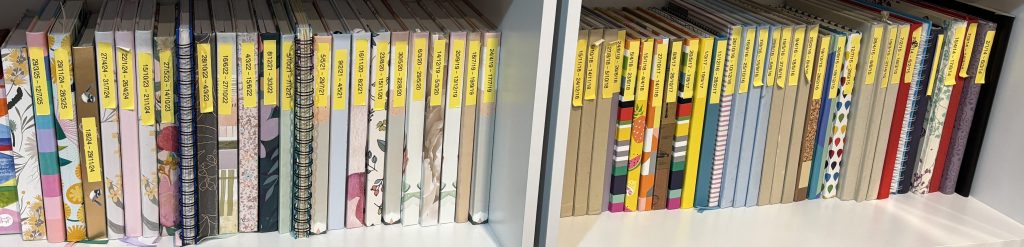
When I think of writing journals, my mind turns to the gathering of books that hold my extensive collection of morning pages. This was a writing routine that I adopted after completing The Artist’s Way by Julia Cameron several years ago. The habit stuck, and writing a couple of pages each day has been an important part of my writing life.
In the past six months, this has transitioned into more in-depth reflection as part of the Intensive Journal Method, developed by Dr Ira Progoff. This has resulted in a shift from the brightly coloured A5 notebooks to more sombre A4 ruled notepaper, but the sense of space to write about whatever is on my mind remains. This is where the mundanity and magic is captured. It provides an outlet for processing everyday events as well as somewhere to think through what is happening in my writing. The act of putting pen to paper is integral to the process, and the results can be surprising.
In A Writer’s Book of Days, Judy Reeves outlines the difference between writing practice and journal writing:
Journal writing techniques focus on going within, writing feelings, reflections, thoughts, and opinions, and provide a forum for processing emotions that arise from introspection. A journal is a place for recording a life, safekeeping memories, dwelling within, and working through. We write to know and express ourselves.
Reeves also notes that whilst journal entries are different from writing practice, the craft of writing is still present. Some content of writing journals “can be lifted whole and transported into a story, essay or novel”. Journal writing and writing practice complement each other, allowing space for the internal and creative worlds to intersect and separate.
A writing journal can be used for different purposes, and it can be a place where a story can be tested, or an idea nurtured. Some writers keep a journal for their novel or larger projects, and I appreciate that this would be beneficial. My journals are different to my writing notebooks, which capture all sorts of ideas, snippets, and images. The contents of my journals are personal; the words, and ideas, are all my own.
For years, my journals were kept in storage boxes, but a couple of months ago, I decided to unpack them. I wanted them nearby, so I could refer to them, dip into them and see what was important at the time. They’re useful when I’m reflecting on places I’ve been or events experienced, and I want to recall what I thought at that moment.
Diaries and journals provide spaces in which we truly get to know ourselves. Three months ago, I wrote the following after reading through some entries:
It is hard to convey just how gratifying it is to visit with past thoughts, feelings, and events … there are records of the brightest and darkest days of my life. Incidents that would otherwise be lost among the accumulation of memories, as fragile and fragmented as they can be, which make up a life.
The entries can be illuminating, and it’s possible to trace a writing idea to its source, when it was merely a thought bubble. A writing journal is a receptacle for hopes, doubts and dreams, somewhere to play with words and not be too serious. It helps me to be ready when inspiration strikes.
My current journalling practice continues to evolve, and it keeps me connected with what is important, which includes writing that is both personal and to be shared.
Do you keep a writing journal? How does it support your creative life?
Photo: shelf of writing journals
Writing resources:
There is a great video here by Nancy Stohlman outlining three reasons why you should start journalling. It is a good reminder of the importance of being warmed up to write, of having a place to play and experiment with your work, and maintaining a relationship with your writing.
If you’ve ever wondered about the differences between a writing journal and notebook, there is an article by Carolyn Greeley which provides a helpful overview. Writers’ Tools: Journal vs. Notebook and How to Use Both outlines how both of them can help improve your writing.
This article by Brandi Reissenweber called Making the Most of Your Journal includes some good examples of how a writing journal can be used. This includes the importance of rereading your journal:
You may find that you connect with something after you’ve written it in a way that you didn’t in the moment you wrote it.
Brandi also notes that it can be beneficial to read through other writer’s journals and diaries. I’ve been dipping into Selected Diaries by Virginia Woolf, along with an old copy of A Writer’s Notebook by W Somerset Maugham and Letters and Journals by Katherine Mansfield. There are also books dedicated to journal writing, including Creative Journal Writing by Stephanie Dowrick. All of these works provide insights into the creative process, and the art of observation.




 jml297
Leave a comment