Talking Turkey: Australian brush-turkey

Written by:

If you are having a wander through a bit of bushland or walking in one of the National Parks in Sydney, you will probably come across an Australian brush-turkey. They range from the far north of Queensland through to the Illawarra region, but have started to make inroads into the edges of suburbia. They are comfortable enough with people around parks and reserves that they will approach and see if there’s any food on offer.
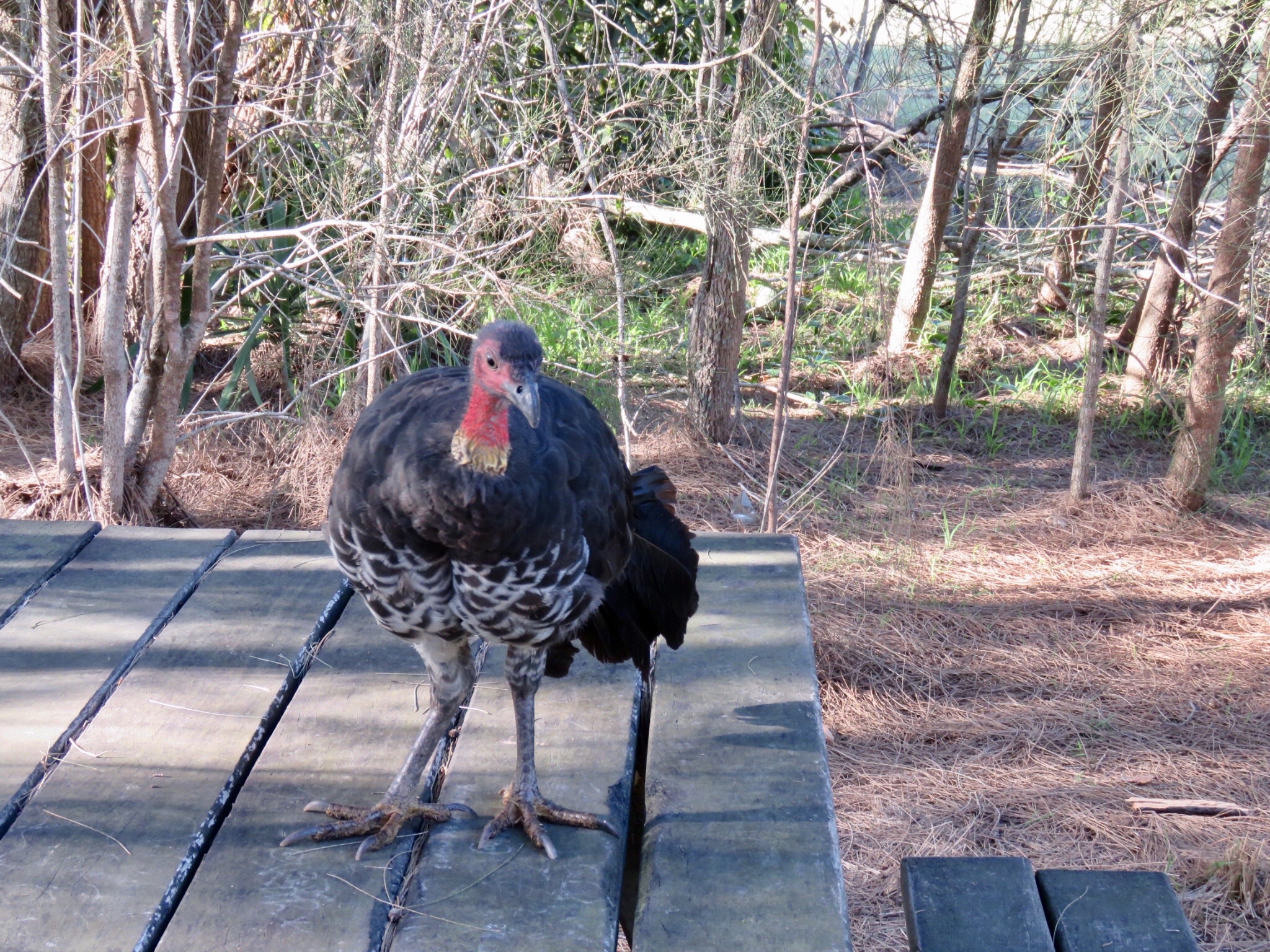
Australian Brush-turkey on a picnic table, Sugarloaf Point, Sydney

It is only in the last 20-30 years that these birds have become a familiar site in the leafier suburbs of Sydney. They are not always desired garden tenants. The male brush-turkey builds a single large nest on the ground from leaves, mulch and earth. These nests can be up to 1.5 metres high and 4 metres across, so they are a significant size. The nest is built and maintained at a temperature of about 35ºC in order to encourage females to come along to breed, with eggs laid into the mound. It can take a couple of months to construct the mound, and the male and female birds test the temperature before eggs are deposited in layers. Several females will lay eggs in a single mound.

The male then monitors the temperature of the mound by ‘tasting’ a sample. The eggs are designed to hatch under the heat generated by the combustion of the organic material in the nest. When the chicks hatch, they need to dig themselves out of the mound and start taking care of themselves, as there are no parents around to provide any guidance. Within a few hours of hatching, the chicks are capable of flying.

Australian Brush-turkey (Alectura lathami) on a reserve at Gladesville, near the Parramatta River

The brush-turkey is the largest of Australia’s three megapodes, and it is impossible to miss the big (mega) feet (pod) on these birds. These are vital not only in the construction of mounds, but for finding food and are also used to aim dirt and sticks at any intruders, such as goannas.

There is something about the shape and mannerisms of the brush-turkey which always draws my attention. There is an article here suggesting five reasons to love brush turkeys for those that have one in their garden. There is a brief video here which shows a turkey building and testing the temperature of its nest. Another short clip is aptly named Australia’s Quirky Turkeys and features some lovely footage up close with these unusual birds.

Have you encountered an Australian brush-turkey lately?

[Photo: Australian brush-turkey and an Eastern water dragon at the Lane Cove National Park]

5 responses to “Talking Turkey: Australian brush-turkey”

  1. Carol Flanagan Avatar
    Carol Flanagan

    These birds are super-destructive, large and powerful, and very determined – a large male can and will dig out a row of metre-high rosebushes if so inclined. I have had to abandon my attempts at growing veges (in my suburban garden in North-western Sydney). They hook out the plants and send them high into the air.We have a female who tries to come inside if a door is left open.
    What’s to like?!?!

    Liked by 1 person

    1. jml297 Avatar
      jml297

      Wow, Carol, you certainly have some assertive brush-turkeys in your back yard. I gathered that they were determined when building mounds, but didn’t realise that they could leave such a trail of destruction with established plants and vegie patches. They certainly have adapted to life in the suburbs in recent years. I haven’t come across any in the upper mountains which is perhaps why they seem a novelty when I come across them in Sydney bushland. Not sure what I’d do if one came wandering into my house … Thank you for sharing your experience!

      Like

  2. billhegerichsr Avatar
    billhegerichsr

    What a fascinating bird! And they seem more than up to the task of taking care of themselves. Thanks for sharing this piece.

    Liked by 2 people

    1. jml297 Avatar
      jml297

      Thanks, Bill. And yes, they seem to be able to fend for themselves quite well. I’m not sure if it’s due to the complete lack of parental attention when they’re born, but I read that they tend to have little tolerance for each other. This morning I chanced upon a couple of them on the central coast and there was definitely no love lost! Thank you for your comments.

      Like

  3. Five Photos: Eastern Water Dragon – jml297 Avatar
    Five Photos: Eastern Water Dragon – jml297

    […] At home on land or in water, eastern water dragons can sometimes be seen enjoying the sunshine on logs or boulders. If they sense danger, or spot prey, they will dive into the water. They can remain underwater for over half an hour, and when very young, small lizards can literally run on the water surface before sinking due to their speed. The photo above shows a dragon with an Australian brush turkey. You can read more about turkeys here. […]

    Like

Leave a reply to billhegerichsr Cancel reply