
Bathurst is a large regional city located about 200 km from Sydney in the Central Tablelands. The Wiradjuri are the First Peoples and Traditional Custodians of the lands and waters of the area. As the oldest inland settlement in Australia, Bathurst has a rich history. There are several museums in the area, including the Bathurst Rail Museum, Miss Traill’s House and Garden and the Chifley Home and Education Centre.

Continuing on a theme from recent posts, one of my favourite heritage buildings is the Bathurst Railway Station. Built in 1876, it is a substantial first class station which reflected the importance of Bathurst as a major country railway site. There is a station master’s residence nearby, and a workshop group. The station building is visually imposing, with Dutch gables and a long verandah to provide some relief on hot summer days. It has been restored recently. There is a detailed history of the station and some great photos of various features of the site available here.

One of the tourist brochures on Bathurst describes the courthouse as “one of the most splendid public buildings in country NSW”. It was built in 1880 to replace an existing courthouse, and due to the demand for post and telegraph buildings, these were constructed first on either side of the building. It is the grandeur of the structure that brings to mind Goulburn courthouse, which was also designed by Colonial Architect James Barnet. The courthouse is still in use for sittings of the court of petty sessions, district and supreme courts.

For some, a visit to the courthouse resulted in a stay at Bathurst Gaol. The first gaol was built in the 1830, and eventually the town grew around it. By the 1860s, the local member of parliament was calling for the relocation of the gaol due to unsanitary conditions. The motion was lost, but by the 1880s plans were in place to build a new gaol. There had been a legislative change which required prisoners to be held in single cells under the 1883 Criminal Law Amendment Act. Construction commenced in 1884, and by 1888 it was completed. The elaborate sandstone gatehouse was designed by the Colonial Architects Office under James Barnet, and was modelled on medieval city gates.
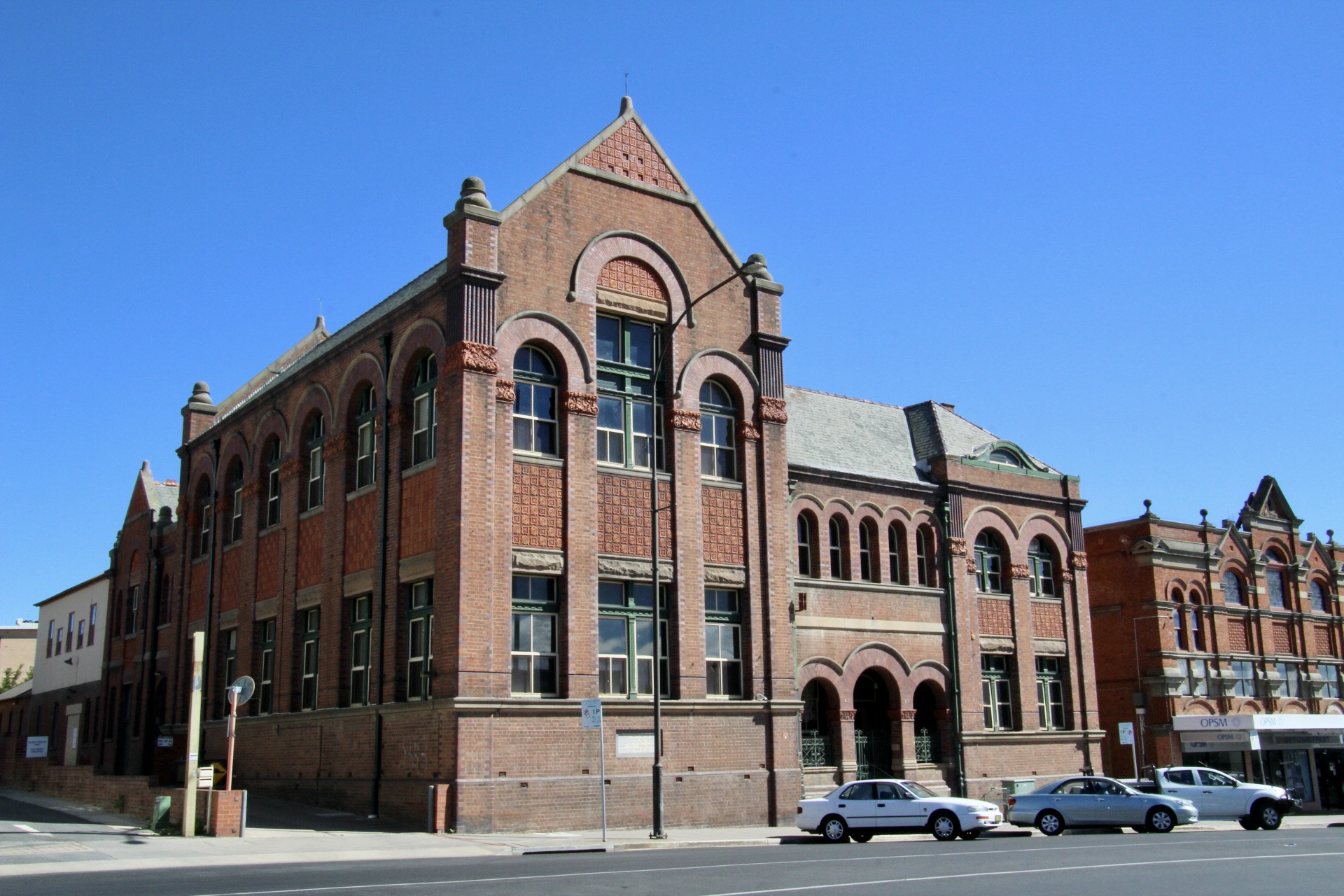
A Mechanics Institute had been formed in Bathurst in the 1840s; by the 1860s it was known as the School of Arts and had its building in the town’s centre. The college had trade workshops and lecture rooms, as well as a museum, an assaying furnace, and laboratories for geology and chemicals which reflected Bathurst’s local industries. In 1897, following lobbying from the local community and School of Arts board, the Technical College was opened. The adjacent ground floor corner was a public museum which included mineral specimens and locally acquired items. The museum operated from the premises until the 1970s; the collection was despatched with some items retained locally, others sent to the NSW Powerhouse Museum, and the rest thrown out. A rare Cobb & Co coach was later returned to the district and can be seen at the Bathurst Information Centre. The future of the building is under consideration, and it is located near Ribbon Gang Lane (site of the first and largest public hanging in Bathurst).

Located in William Street, on the site of the Carrier’s Arms Inn, is the General and Savings Bank Co. building. It was later the Bank of NSW, and now Westpac, premises. In 1851, the discovery of payable gold was announced at the Carrier’s Arms Inn by Edward Hargraves. The Australian Dictionary of Biography describes Hargraves as a “gold rush publicist”: the gold had been discovered by his associates, William and James Tom.
Bathurst has a rich history, playing an important role in the expansion of the colony and was the site of the original gold rushes in New South Wales in 1851. The importance of this inland city continues to grow, and to be echoed in its historic buildings.
Photo: Bathurst streetscape




 jml297
Leave a comment