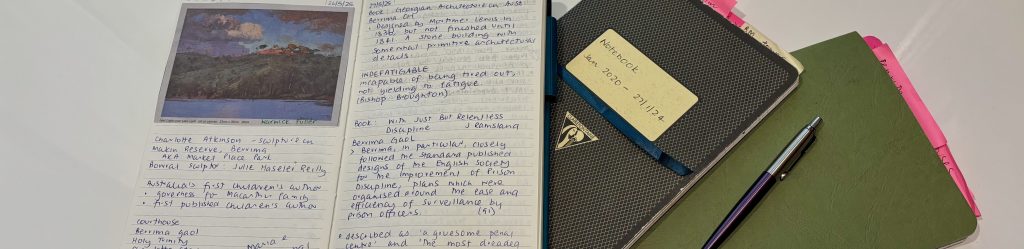
I recently read a section on writing notebooks in The Notebook: A History of Thinking on Paper by Roland Allen. This included an overview of the way different writers have utilised notebooks to support their writing life.
For example, Agatha Christie used school exercise books to keep track of her plots and characters. Over 70 of these books were accumulated over the years. For a writer known for her intricate plots and myriad approaches towards dispensing of characters, her notebooks reflect a less linear approach. Entries are only occasionally dated, and often without the year to make it additionally challenging to work out when the notes were recorded. Novels are plotted over multiple notebooks, with references to characters and plot points scattered among shopping lists, notes from phone calls and bridge game scores.
Patricia Highsmith employed a more structured approach. Like Christie, Highsmith was consistent with her choice of notebook (Columbia thick student jotters), but her entries were more ordered and the journals were numbered in sequence with a summary of contents or themes on the cover.
Both writers used the notebooks for a wide range of record keeping, as well as a space for testing out ideas and gathering material. Another writer listed in the chapter, poet and essayist Paul Valéry, had accumulated over 260 copybooks. His daily practice included a five am start to add material to the collection.
My use of writing notebooks has changed over time, and will continue to do so. I use a mix of online note apps to capture thoughts and ideas when on the move. Over the last couple of years, Microsoft OneNote has been helpful for gathering a wide array of thoughts, links, and pieces of information in a virtual scrapbook. I have a physical notebook that I use to jot down ideas, words, story starters and research. All of this could be done online, and over time more of it is, but there is something crucial for me in the simple act of putting pen to paper.
Entries in the notebooks may be intermittent, but they are dated, and the current notebook I’m using has numbered pages and an index option at the front. For years, I wrote primarily in Clairefontaine notebooks as I loved the texture of the pages, and they coped well with gel or ink pens. Once finished, these notebooks bristle with post-it notes of the main topics or themes, or story ideas that came upon me and simply had to be written out by hand in the moment to capture the essence before it evaporated.
Looking back at these notebooks is always a revelation. They track things that interested me at the time, and to see the development of themes is rewarding. Other entries note passing phases. If I encounter interesting or unfamiliar words, they are captured here, along with their meanings. There are names of birds and plants, common and scientific, that I come across on my travels, along with potted histories of places. Occasionally, I’ll paste in pictures of paintings that are featured in the Blue Mountains Gazette if they catch my eye.
My writing notebook is something that travels with me, that I add to, and feel more complete in simply having it nearby. It is ready to capture and help with the construction of thoughts and ideas, a place to hold some ephemera of a curious life. Do you have a writing notebook, physical or virtual, at hand?
Photo: writing notebooks
Writing resources:
Interview with Australian children’s author Katrina Germein about how she uses her physical and online notebooks in her writing life.
Post on Substack by Katherine May about writing notebooks; how they have two lives. One is getting the words and ideas down on paper, before they dissipate. The second life is when the notebooks are re-read, tracking the evolutions of ideas.
“Messy attics of the mind” in the Guardian provides insights into how contemporary writers use writing notebooks to capture ideas and develop stories.
There is a comprehensive review of The Notebook: A History of Thinking on Paper on Notebook Stories.




 jml297
Leave a reply to On Writing Blog Posts – jml297 Cancel reply