Writing dreams exist on many levels. There are the dreams of what we may hope to achieve with our writing — fame, fortune, our name on a published book or as a writer of a screenplay, perhaps. And then there are those ephemeral dreams that can sometimes transgress the boundaries of sleep into wakefulness. It is the second type of writing dreams that I’m referring to here.
I’ve recorded snippets of dreams at various times across the years. In my experience, pinning them down as soon as you can works best, even if they seem to remain a jumble of thoughts and images. Often the fragments that I can recall can be traced back to something all too mundane that I’ve been cogitating on overnight. But then, just when I least expect it, I have a ‘story dream’. These are vivid segments of a cohesive tale that persist as I shift into wakefulness.
Over the years, I have had several short story or flash fiction dreams. There can be a degree of vivacity about the stories and images that really capture my attention. I have a draft version of a longer short story that I’m reworking that originated from a dream: the characters, location, and sources of conflict were so clear on awakening, that it was challenging to write fast enough to get it down. Another recent dream is also being explored: this one has the potential to be a novella or perhaps longer. And a third is now a short story, ready for its final edit.
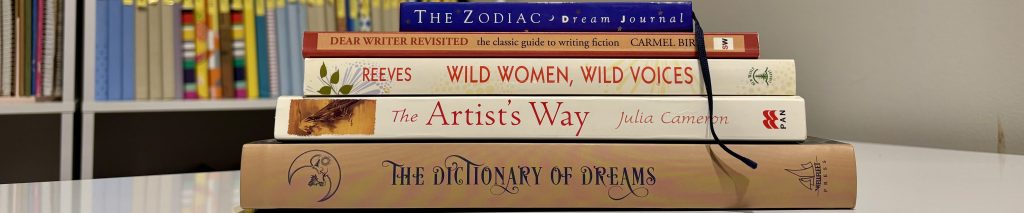
The role of dreams for writers is described as follows under a section called Dreams: Gifts of the Night in Wild Women, Wild Voices by one of my favourite writers on writing, Judy Reeves:
Dreams can answer questions and solve problems. They can influence our writing and, in turn, our creative work can alter our dreams.
In the harsh light of day, a more critical eye might question the merit of capturing these elusive writing ideas. Not all bolts of inspiration can be teased out into something that has enough substance to stand alone. But they can be a great starting point, and when they do arrive, sometimes fully formed, there is a sense of wonder and gratitude at what the brain is capable of coming up with whilst in a state of rest.
Even if most dream stories can’t make the journey into fiction, they can provide a depth of imagery and creativity to support writing projects. In Dear Writer by Carmel Bird, there is an acknowledgement of the richness that dreams can provide, including solutions to writing problems.
A record of your dreams can be a rich source for your work. It is the story of part of your inner realities, and from it you may in time be able to fashion a world of fiction. The retelling of dreams, your own and those of your characters, is not always successful in fiction. Watch out for that.
Not everyone can recall their dreams, of course, and some of us may be able to remember a fragment or perhaps experience a sense of déjà vu if something from a dream is echoed in the reality of the day. By paying attention and capturing some imagery of dreams, it can form a further connection with your artistic life. In The Artist’s Way by Julia Cameron, some of these changes resulting from a greater connection include dreams:
Your dreams will become stronger and clearer, both by night and by day, and by day daydreams will catch your attention. Fantasy, of a benign and unexpected sort, will begin to crop up.
Recently, I have been actively recording my dreams daily as part of the Intensive Journal process. My current technique for doing this is to record the dream as a voice memo as soon as possible upon waking. I then use the transcription option to copy and paste the dream elsewhere, do a quick edit and print them. This creates a literal stack of possible writing inspiration, along with some insights as to what I’m really preoccupied with. Like panning for gold, there may be a lot of dross, but the flicker of gold makes it worthwhile.
Do you keep track of your dreams? Are creative sparks and solutions found in them? Have you experienced the joys of a story dream?
Photo: stack of dream books
Writing resources:
Curious about what your subconscious may be trying to tell you in your dreams? Here is an article on 14 Common Dreams and What They Really Mean. If you’ve dreamt of running late, meeting someone famous, or of your teeth falling out, you’re not alone.
Many creatives have found inspiration in their dreams. Writers including Charlotte Brontë, Stephen King and Franz Kafka wrote famous works that began as a dream.
Some benefits of recording your dreams include greater personal insight, identifying and processing emotions, and solving problems. There are some suggestions on how to keep a dream journal here.





 jml297
Leave a reply to jml297 Cancel reply