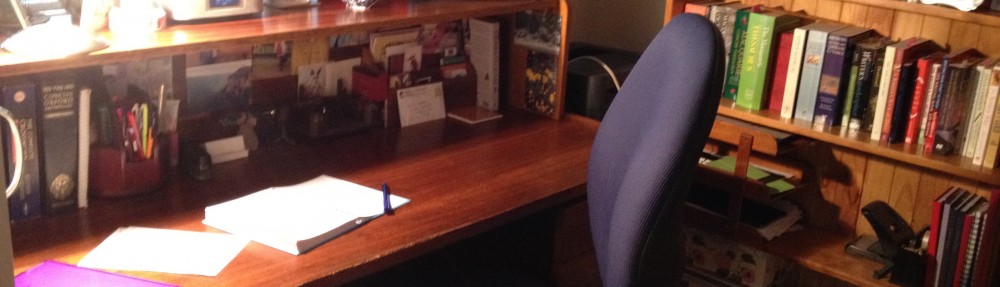
For over twenty years, my writing life has been anchored by the same desk: a large wooden piece with a hutch and three drawers. It has followed me through every place I have lived, carrying the marks of an earlier life in an office somewhere else. I write in other spaces, but it is hard to imagine moving without the desk where I have dreamed, schemed, created stories, and attended to the inevitable administration that accompanies a writing life.
There is a wonderful description of a eucalyptus writing desk, made specifically for a young girl’s room, in the opening pages of The Lost Flowers of Alice Hart by Holly Ringland:
It was made from the creamy planks of spotted gum he’d been saving to build Alice’s mother a new fernery. Alice hovered in the corner of her room while her father bolted the desk to the wall under the windowsill. It filled her bedroom with the heady fragrances of fresh timber, oil and varnish. He showed Alice how the lid opened on brass hinges, revealing a shallow underbelly ready to be filled with paper, pencils and books. He’d even planed a eucalyptus branch into an arm to hold the lid up, so Alice could use both hands to fossick inside.
I worked from home for a couple of years. At first, my workspace and writing space were one and the same, before I moved my work into an underused bedroom. This became my “workroom”. When it was no longer needed for that purpose, it remained—now lined with writing journals, books, and works in progress. It has become one of my favourite places to be, surrounded by words, thoughts, ideas, and worlds of my own making.
At first, this felt indulgent. Yet the value of having space—or a room of one’s own—in which to create is well acknowledged. I’m fortunate to have several places to write in my home and to move between them according to the work at hand, the time of day, and the quality of light. Sometimes that means sitting outside at a table, or at a narrow desk with no technology, looking out over the garden’s greenery.
In Write for Life, Julia Cameron notes that she has four writing stations in her house, each with its own character, and that she moves between them according to mood and time of day. Other writers thrive in external environments such as cafés, finding the steady hum of conversation a useful backdrop. I do this occasionally, though mostly for short bursts of writing or a little discreet eavesdropping to tune my characters’ conversations. Headphones or earbuds are usually effective at minimising interruptions.
Judy Reeves, in A Writer’s Book of Days, also suggests writing outdoors, in libraries, or in bookstores with cafés and tables. She includes train stations and airports—places of transit—as well as bars, lounges, beds, and cars. Writing is a particularly portable art form, and some writing centres even offer quiet rooms that can be booked for dedicated sessions.
That portability is useful, especially when ideas arrive away from familiar spaces or at inconvenient times. Yet over time, my writing life has been shaped as much by return as by movement. The steady act of coming back—to the same desk, at a regular time—has become part of how the work begins. Anchored there, amid marks left by earlier lives and my own, my mind knows how to settle, and the writing finds its way forward.
What does your writing space look like? How does it support your writing life?
Photo: writing desk
Writing resources:
- Tips on setting up or improving a writing space can be found in an article by the NY Book Editors, including advice on chair and desk selection.
- Writing spaces evolve, as illustrated by Dina Nayeri, whose work spans basements, cafés, and a bedroom outfitted with headphones to block the outside world.
- A voyeuristic glance into the writing spaces of well-known authors—including Ernest Hemingway, Hilary Mantel, and Alice Walker—is hard to resist. As writer Cully Perlman notes, where you write isn’t critical; it is the writing that matters most.


 jml297
Leave a reply to Lisa Hill Cancel reply